Announcement

Collapse
No announcement yet.

Old radio gear....

Collapse
X
 
  • Filter
  • Time
  • Show
Clear All
new posts

  • #16
    were the Ace Micropros early 90's or early 80's ?

    Why does it seem like 1990 was so recent - it doesn't seem that long ago !!


    This post frightens the life out of me - the technology advances in the last few years into stuff we take for granted are outstanding. What will we have in 2020 ???

    sigpic Trex 700 OS91,Vbar,S9254,DS610,NHP
    Trex600LE, OS50,Vbar,LTG6100,DS610X4,NHP
    Raptor 30V1 Maverick Head
    OctoCopter
    Futaba 14SG


    Guinness World Record Pilot 2011/12


    Comment


    • #17
      Hi Pete - yes, I reckon it was about 40 years! We had a beer in Piccadilly when you were (I think) working for the BBC?

      Some prices from the April 1965 edition of Model Aircraft:

      Grundig 8-channel Tx: £42/10/0
      Grunding Superhet RX: £27/10/0
      Grundig tone filters: £9/15/0
      Graupner Bellamatic II: £5/15/0
      Graupner Servo Automatic: £3/12/6

      RCS Guidance System single channel Tx & Rx: £15/0/0
      Elmic Commander escapement: 59/2

      Special "Combo" offer from Roland Scott (Derby) for a Carl Goldberg Junior Falcon, RCS Guidance System, escapement, harness and Cox Babe Bee with all batteries included: £22/0/0!!

      Typical multi-channel reed system (F&M Matador/Midas 10-channel superhet without servos): £87/10/0
      Bonner Transmite servos: £11/16/0 each
      Metz 10-channel Tx, superhet Rx and 5 servos: £150/0/0
      Flight Link proportional system: £89/0/0 (not your favourite, eh Pete?)
      REP Twin Triple: £30/19/5 (This was basically a 2-channel system which used 3 Elmic rubber-powered actuators to provide rudder, elevator and throttle control - if you could remember the pulse sequences!).

      Veron Robot: £4/3/6
      Keil Kraft Super 60: £5/9/11
      TopFlite Taurus: £16/10/0
      Graupner Consul: £4/12/0

      Engines:

      Cox Tee Dee .049: £4/16/9
      PAW 1.49 diesel: £4/6/0
      PAW 19 BR diesel: £6/6/0
      Merco 35 R/C: £7/12/6
      Merco 61 R/C: £12/16/0

      Grundig had just released a 10-channel Variophon S at £54/10/0 for the Tx alone. So the full 10 channel set up would have cost £155/5/0 excluding DEACs!! Meanwhile, RCS had released the 'Inter 6' 6-ch reed system for £69/10/0 including a pre-wired Climax 3 servo pack and DEACs.

      I hate to think what these prices would be in today's money! Mind you, compared with some of the utter junk being sold a mere 2 years earlier, the Grundig system was really very upmarket and reliable.

      Comment


      • #18
        Originally posted by Mslater View Post
        were the Ace Micropros early 90's or early 80's ?

        Why does it seem like 1990 was so recent - it doesn't seem that long ago !!


        This post frightens the life out of me - the technology advances in the last few years into stuff we take for granted are outstanding. What will we have in 2020 ???
        Late 80's / early 90's according to this post on rcuniverse:
        ACE MicroPro 8000 Transmitter Service

        MicroPro History as I know it by Dan Thompson, 6-17-06.

        ACE RC has had been around since the 1950's building, designing and selling radio control equipment. In the late 1960 or early 1970's they produced the Olympic/Silver 7 series of transmitters. This series of transmitters, encoders and RF decks, were designed by Fred Marks of FMA for ACE.

        In RCM December of 1987 there appeared a new RC transmitter encoder that used a microprocessor for the encoding. It used LEDs as the visual aid for programming. This encoder was the Brain child of Marty and Tom Hendrickson of Emulation technology. A later version used an LCD as the display device.

        Somewhere in this time frame ACE contracted with Emulation Technology and with the Silver 7 as a base they integrated the Hendrickson encoder and produced the MicroPro 8000. I believe the MP8K was introduced by ACE about 1989 or 1990. They offered complete transmitters or an upgrade kit for your Silver 7. As far as I know the MP8K was the first commercially available computer controlled transmitter.

        ACE ceased production of the MP8K in 1997 after producing approximately 3500 units. Of course it was shortly afterward ACE was sold to Thunder Tiger.

        The Hendrickson's gave me the source code for the MP8K in November of 2004 with restrictions on distribution. These restrictions were reasonable and allowed me to enhance the functions of the MP8K. It needs to be stated at this point that the MP8K was far ahead of it's time. The Hendrickson's had done a super job of functions. At the time, who would have thought of all the mixing possibilities in the transmitter. The MP8K still today, has an auto trim function that is not available on any other commercial transmitter. The level 4 software allowed you to program flight setups on your PC and download them. In May of 2006, the Hendrickson's gave me unrestricted rights the the source code.

        A level 5 EPROM is available to upgrade the transmitter for more functions like naming and dual elevator servos. A module that plugs in the com port that allows you to keep your setups in your flight box. Level 6 is in the planning stages.

        The MP8K is still today only perhaps superseded by maybe two top of the line transmitters which cost $1000 to $2000. The MP8K still is more radio than can be utilized by 80% of the fliers.

        Bit more about the Ace Micropro here:

        https://sites.google.com/site/mp8kinfo/home
        Proud Sponsor/Pitman/Servant/Slave to Bart101s fleet of Outrage and Avant helicopters
        Bart101 suffers from a medical condition called "Compulsive Inpulsive HeliAddict"


        sigpic X3

        Comment


        • #19
          My Ace MicroPros date from the early 90's - according to the QC stickers inside! My twin-stick one has level 3 firmware, whilst the single stick (and another twin-stick - unused so far) are both level 4. There is now another computer radio project in the States for an even more sophisticated transmitter - the MicroStar 2000

          Welcome to the Frontpage

          This has full heli functions built in, and is also available as a "daughter board" to retro fit into the MicroPro 8000! Guess what my next project will be.......

          And for those of you puzzling over Nick's post, those prices are in proper money - Pounds, Shillings, and Pence (or LSD, as it was known!). None of this metricated rubbish here! (Bah! Humbug!)

          So the Veron Robot at £4/3/6 would correspond to about £4.175 in decimal, or probably about £45 today (maybe even more!), allowing for inflation!

          I leave it for other readers to work out the equivalent cost of the radio gear, but be prepared to need a good stiff drink afterwards!

          And remember, much of the radio gear of that era was of questionable reliability - at least compared to todays stuff - and required constant tinkering to keep it going. The Grundig was a bit of an exception here! Even the Digimite required the servos to be regularly stripped down and the pot tracks cleaned and lubricated!

          It does throw the present row over the DX-8s into perspective, and may lead you to understand why us old farts tend to shake our heads in amusement at some of the complaints we read about equipment failures!

          Pete

          No matter how much you push the envelope, it'll still be stationery.

          Comment


          • #20
            Actually the Grundig Variophon Tx also needed a little maintenance now and again. I listened to the transmissions on a 27 MHz receiver and noted that the tones tended to warble slightly if the Tx switches weren't held fully over - not much use when 'pulsing'! A blast of switch cleaner usually sorted that out though!

            I'm surprised that the Bellamatic servos were as reliable as they proved, with those exposed workings between the motor output shaft and the bellcrank plate.

            If I recall correctly, the reason why Grundig's tone filter system was so reliable was that the tones could be over a much wider audio range than was possible with a reed system and each tone filter could be made with sufficient allowance for slightly off-tune audio tones, whereas if a reed system was off-tune, it would be very probable that a neighbouring reed might respond. Great fun getting full aileron when all you wanted was idle throttle! 12-channel systems were the absolute limit, but even they needed frequent twiddling to stay on-tune; I'm sure that they were also temperature-sensitive so that what might have been fine in a warm workshop (were there such places?) would have been off-tune on a cold UK flying field!

            Comment


            • #21
              Good point about the temperature stability! The ED reed sets actually had the tuning pots on the front panel, so that if a function stoped working, you could tweak it in flight! One hand to hold the tranny, one to hold the switch over and the other to tweak the pot! Oh! Hold on a sec.....!


              Because the reed banks were mechanical, a transmitter would have to be tuned to its individual reed-bank, and would be most unlikely to work another without retuning! So if you wanted two models, you not only had to have two receivers but two transmitters as well!

              As Nick correctly points out, the Grundig was much more tolerant, and any Tx would operate any Rx! In fact in my club at the time (Teignmouth), we only had three transmitters - John Haytree's, mine and a chap called Barry whose surname is lost in the mists of time! Everyone else borrowed our transmitters!

              Happy days!

              There are a couple of guys resurrecting old radio gear over at http://www.singlechannel.co.uk/

              Well worth a visit!
              Pete

              No matter how much you push the envelope, it'll still be stationery.

              Comment


              • #22
                Yes, holding the 5lb ED Black Prince Tx in one hand, with its 60" antenna blowing about in the wind, whilst trying to twiddle the pot.... They really knew about ergonomics down at Electronic Developments (Surrey).

                I did like the comment in that advert, stating that 'only' 30v HT was needed for the half-pound Black Arrow Rx, allowing the use of 'quite small' batteries.... ;-) Quite small as compared with what, I wonder?

                Oddly enough, back then the trend was for smaller and lighter radio equipment - yet nowadays models seem to be getting bigger and bigger with huge 4-stroke engines of 30cc or more. Whatever happened to .049s?

                Comment


                • #23
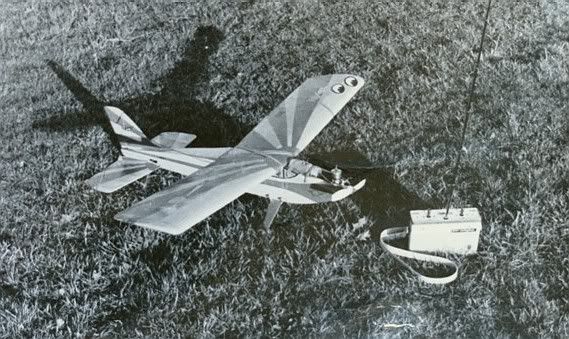
                  I know that this is a helicopter website, but I've just found an old photo of my Robot taken in December 1967:


                  I can still smell the diesel fuel in my mind - and my right index finger is twingeing at the thought of flicking that 8x6 prop on a cold winter day!

                  No silencers back in those days - at least everyone knew when I was flying. Just as well, since it only had a super-regen receiver!

                  Comment


                  • #24
                    Shame the picture is black and white! It doesn't quite reproduce the glaring red and yellow that I recall!


                    Look forward to meeting up sometime soon!
                    Pete

                    No matter how much you push the envelope, it'll still be stationery.

                    Comment


                    • #25
                      Colour film? A luxury back then!! Yes, it was indeed bright red and chrome yellow! With black and grey 'cabin windows'.

                      A nice design, the Robot. Easy to build, pretty tough and also nice and stable in flight.

                      Thanks for your e-mail, Pete - I've sent you a reply!
                      Last edited by nickwilcock; 03-05-2011, 05:00 PM.

                      Comment

                      Working...
                      X