If this is your first visit, be sure to
check out the FAQ by clicking the
link above. You may have to register
before you can post: click the register link above to proceed. To start viewing messages,
select the forum that you want to visit from the selection below.
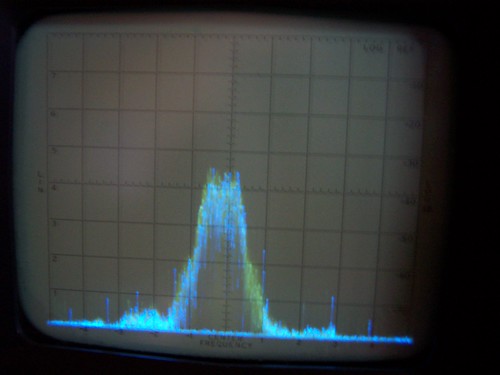
Here's a shot of a single DSM-2 channel taken off a spectrum analyzer (you wouldn't believe how difficult it was to get that shot!):
As you can see, its about 1 MHz wide (that's 1 MHz/cm on the graticule).
The way the "direct sequence" bit works, it would require quite an extra-ordinary form of interference to wipe it out. The "spreading code" takes a fairly narrow band signal, and spreads it out over a much wider bandwidth - for example, a 100 KHz signal gets spread over 1 MHz. In the process, tha absolute amplitude of the signal gets reduced (think tipping a tall glass of beer into a soup dish), but the total energy of the signal (the amount of beer) remains the same.
When the signal is received, it is "de-spread" using the same algorithm (tip the beer back into the glass), BUT any interfering signal will be "spread out" by a corresponding amount. The result is that the wanted (de-spread) signal now has a MUCH greater amplitude than the unwanted interference (the beer in the glass is taller than the interference now in the soup bowl) and is therefore easily separable.
A DSM system can actually recover a useable signal from below the noise floor! It was, after all, designed to be used by spooks as an undetectable means of communication!
Now I agree that no form of radio communication is completely immune to being swamped, but I would argue that to overwhelm a DSM signal takes some doing, and is not something that is very likely in practical situations!
To come back to the OPs question, it really doesn't make any difference from a technical standpoint. The only time people appear to have problems is when mixing DSM-X transmitters with DSM-2 receivers, and vice-versa. And this could be down to not understanding the requirements for such a mix properly. (Actually, I seem to recall there was a software bug (?) in early DSM-X transmitters that was fixed with a firmware update, so that last comment may be a little unfair!)
I have a silightly clearer trace of the spetrum DX8 output waveform taken in a chamber with a reasonable spektrum analyser. It clearly shows the 23 channel output that is distinctly different tothe DSM2 standard that has only two peaks.
Yes, an analogue video transmitter has a bandwidth of about 8 MHz, and is one of the few things that might cause a problem! Having said that, I've never noticed my DSX-9 select adjacent channels particularly frequently. It seems to select them randomly, with opposite ends of the band being just as likely as nearby. It seems to select a reasonable space most of the time.
Of course, an analogue video camera would also have an adverse effect on anything in the band - even frequency hopping, though in that case it would just increase the latency. The moral? Don't use a 2.4 GHz video downlink with a 2.4 GHz control system! (Common sense really!)
The only time I've heard of this causing a problem was when a club discovered a chap using highly illegal powers for a video downlink just up the road......!!!
Thanks for the update on the software bug. I knew it was a weird one, but presumably its all sorted now!
As a total aside (and before anyone accuses me of being a cheerleader for DSM-2), I've been using a Frsky 2.4 GHz setup in fixed wing for about a year now, and I'm *very* impressed with it! Its a frequency hopper, the receivers are cheap, and it just works! So far, I haven't been able to fault it! For the price, its unbelievably good!
Pete
No matter how much you push the envelope, it'll still be stationery.
[...]The only time I've heard of this causing a problem was when a club discovered a chap using highly illegal powers for a video downlink just up the road......!!!
[...]
Yes !
Which is a real-world illustration of my point. A whole load of 2.4GHz stuff happilly co-exsists - until you get something naughty appear; which is completely outside your control.
Under those conditions, the frequency agile kit's performance degrades more gracefully.
I can happilly accept this is not a common occurrence. However: if you can readilly mitigate the problem (eg DSMX instead of DSM2), it makes sense to; and, feelings seem to be that this kind of problem in the 2.4GHz band will get more common.
I'm basically pushing back against the school of thought that says DSMX has no advantage except at big events (that you don't get in the UK). It may not be necessary, but it has benefits.
I reckon I've had DSM2 lock-outs - but possibly due to flying in a room over an RF/network lab..!
Every radio system can fail. My point about DSM2 was that there is a clear part of the protocol that nobody follows. That is each tx needs to be able to see other txs and to choose unoccupied bands or channels. My main issue is that 2.4Ghz has been sold as foolproof whereas it is not. Communication failiures occur frequently on every flight. Because of the redundancy of two channels in DSM2 the system can still work with only one usable band in use unless there is a link back from the rx to monitor true signal quality. As you say because of the nature of spread spectrum and the time division multiplex of the system it is possible and perhaps even likely that two txs can accidently share the same channels and continue to work. They will not be working optimally, though, and depending on the closeness of the txs frequency there may or may not be losses of control as the two txs transmit at the same time. We have very complex systems that are difficult to predict because we have thrown away the pegboard and because no monitoring is done on local reception conditions.
With more frequencies being used by DSMX, Futaba, Multiplex and others there is at least some protection against the random way we all use 2.4GHz in that it doesn't matter if other txs are in the next field or close by. I use both DSM2 and Multiplex Frequency Hopping and feel uneasy about DSM2 when lots of 2.4Ghz txs are in use. I think DSM2 may be better if the average club user followed a switch on protocol and if the tx reported the frequencies in use. It does however depend on what sort of interference is experienced at a given site and how long a model can survive no signal.
We now have flybarless sytems and it is already possible to ignore transmissions except from your own tx by using appropriate CRC checks which can easily be made so secure that we can forget about the problem. We probably need to have a proper fallback where the onoard computer takes over and hovers or lands the heli safely.
The place for frequecy control is really in the rx, as it is the signals that the rx can see that define if a channel is working. This information can be used to control the tx frequency use and keep the number of channels in use down to a minimum, ensuring a proper sharing of spectrum. The tx time division multiplexing frequecies can also be controlled so that txs can share the same channels if necessary, but not in the same time slot.
This does mean that all systems should follow the same protocols which is what we had with 35Mhz and type approval.
Luckily at the moment our systems work very well, but there is no guarantee that this will continue as more and more wireless devices appear. How did we end up with a situation where mobile phones use a radio control frequency and laptops with WiFi and most switching freqencies randomly. I hope all other users find 2.4Ghz too slow for their data and then we may be left behind, until a FPV flies by wanting to have a look at activity on our field.
My main issue is that 2.4Ghz has been sold as foolproof whereas it is not.
Absolutely! Couldn't agree more!
Most people don't realise that if our models were to be built to the same level of reliability expected of full-size aircraft, they would cost the same! And even full-size ones fail occasionally......!
Pete
No matter how much you push the envelope, it'll still be stationery.
That is true in the limit. Our craft would have to be full size. Technology does keep going down in price and things that used to cost a lot are now affordable. We gain from real world research into car electronics and the rising price of petrol. There are a lot of things that can be done without increasing cost. Saying that a system is bulletproof doesn't help, or making it so complex that people can't tell the difference between an expected and an unexpected fault. Managing complexity is made very difficult when the system performance is hidden.

 Tweet
Tweet


Comment